
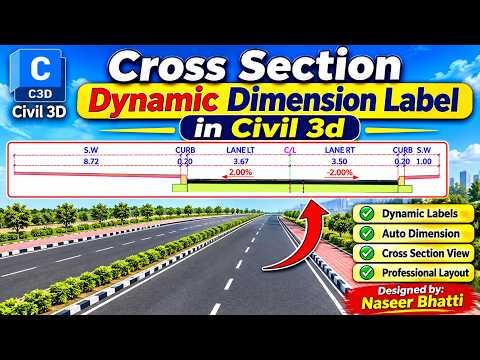
Manual dimensioning in roadway design is not only tedious, but it also opens the door to costly errors during project revisions. If you work on complex infrastructure projects, mastering dynamic annotation tools within Civil 3D can dramatically boost your drafting efficiency and overall design accuracy. Dynamic cross-section dimension labels allow civil engineers and CAD technicians to automate road dimensioning seamlessly, ensuring that any geometric change to your corridor immediately reflects across all section views.
Why Use Dynamic Dimension Labels?
Traditionally, updating cross-section dimensions required tedious manual edits whenever an assembly offset, lane width, or slope changed. Dynamic cross-section labels solve this bottleneck by linking directly to your underlying design objects.
When you apply dynamic labels, the dimension values automatically recalculate whenever the cross-section geometry updates. This drastically reduces drafting turnaround time and eliminates discrepancies between your actual corridor model and the final construction plan sheets.
Key Benefits of Automatic Road Dimensioning
- Real-Time Updates: Modify assemblies, corridors, or surfaces, and watch your cross-section dimension labels update instantly.
- Enhanced Precision: Manual measurement errors and transcription mistakes are virtually eliminated.
- Standardized Presentation: Maintain consistent annotation styles across all section sheets for clean, professional deliverables.
- Faster Review Cycles: Spend significantly less time revising annotations during client revisions and quality control checks.
Elevate Your Roadway Design Workflow
By setting up tailored label styles linked to subassembly points and feature lines, Civil 3D extracts precise geometric data automatically. Whether you need to dimension lane widths, shoulder slopes, curb heights, or right-of-way limits, dynamic labels fetch accurate values directly from the cross-section components.
Integrating dynamic cross-section dimension labels into your project templates is one of the easiest ways to streamline your production workflow. By letting Civil 3D handle repetitive annotation tasks, you can focus on making critical engineering decisions and delivering high-quality drawing sets in a fraction of the time.


