
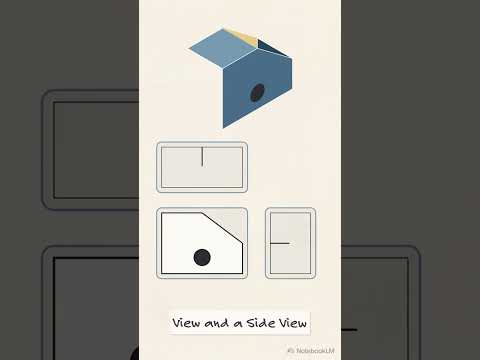
In modern design and manufacturing, transforming a 3D physical model or CAD concept into a clear blueprint is a crucial skill. While 3D models give us an immersive view of an object's spatial dimensions, manufacturers ultimately rely on a precise 2D drawing to fabricate parts accurately. Understanding how to convert three-dimensional objects into flat technical representations is foundational to modern engineering.
What is Orthographic Projection?
The core technique behind converting a 3D object into a 2D format is known as orthographic projection. Instead of looking at a part from a single perspective, an engineer projects the object onto imaginary flat planes from multiple standard angles:
- Front View: Displays the primary shape, height, and width.
- Top View: Reveals the depth and alignment from directly above.
- Side View (Profile): Gives additional depth and height details to eliminate visual ambiguity.
By aligning these views side by side, a complex spatial concept is simplified into clear, standard representations that anyone in production can read.
Key Elements Included in Technical Drawings
Creating an effective 2D drawing requires more than just flattening geometric shapes. It must communicate critical manufacturing details that a raw 3D model cannot easily convey on a shop floor:
- Dimensions and Tolerances: Exact measurements and acceptable variations in size.
- Material Specifications: Guidance on metals, plastics, or finishes needed.
- Sectional Views: Internal details revealed by "cutting" open the 3D model.
- Title Block: Critical metadata including project name, revision history, and scale.
Why Technical Schematics Remain Essential
Even in an era dominated by advanced 3D CAD software and 3D printing, technical schematics remain the universal language of global manufacturing. A high-quality 2D drawing serves as a legal contract and quality control reference, ensuring that parts manufactured anywhere in the world fit together perfectly. Mastering this conversion process bridges the gap between creative design and real-world production.


