
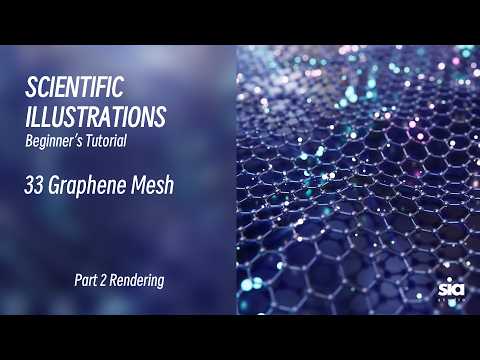
In the world of science and research, clear communication is everything. Whether you are publishing a paper in a high-impact journal, presenting at a conference, or building educational media, 3D scientific visualization brings abstract concepts to life. If you are just starting your journey into digital art, mastering Cinema 4D is one of the most effective ways to produce publication-ready graphics without getting bogged down by overly technical workflows.
Why Choose Cinema 4D for Scientific Illustration?
3D software can often feel daunting to beginners, but Cinema 4D stands out for its intuitive user interface, powerful procedural tools, and robust rendering capabilities. From complex molecular structures to nanoscale engineering materials, it gives researchers and digital artists the precision needed to translate detailed scientific data into visually compelling artwork.
Step-by-Step Focus: Modeling a 3D Graphene Mesh
One of the most iconic structures in modern material science is graphene—a single layer of carbon atoms arranged in a two-dimensional honeycomb lattice. Creating a seamless graphene mesh is a fundamental exercise for beginners that teaches essential 3D techniques:
- Setting Up Procedural Geometry: Utilize parametric primitives and generator objects to build a clean, perfectly aligned hexagonal lattice structure.
- Applying Realistic Materials: Scientific renders require clear, professional aesthetics. Learn how to assign materials and shaders that give atomic bonds physical depth and clarity.
- Lighting the Nanostructure: Strategic studio lighting highlights the fine details of the lattice, separating your mesh cleanly from the background.
Elevate Your Visuals with Professional Rendering
Building the 3D model is only half the process; rendering brings your scientific asset to life. Proper camera placement, subtle depth of field (DoF), and soft ambient shadows transform a simple geometric grid into a polished, cover-worthy illustration. By establishing a systematic workflow, you can consistently produce renders that meet the visual standards of top academic publications.
Start Building Your Scientific Art Portfolio Today
Scientific visualization bridges the gap between complex raw data and intuitive human understanding. Whether your goal is to depict biomolecules, physical simulations, or nanostructures, learning Cinema 4D provides all the tools you need to turn abstract scientific theories into striking visual realities.


