
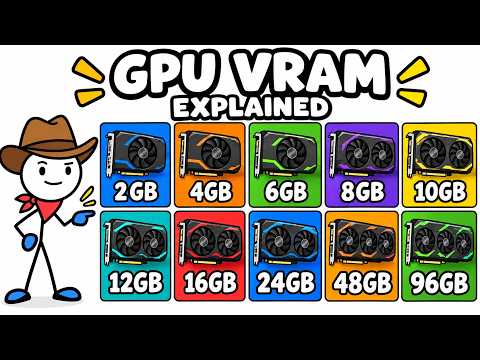
Graphics Processing Unit (GPU) VRAM plays a critical role in your system's overall performance. Whether you are building a budget gaming setup or a dedicated workstation for 3D rendering, choosing the right amount of VRAM ensures smooth workflows and eliminates annoying performance bottlenecks. But with GPUs ranging anywhere from 2GB to a massive 96GB, how much video memory do you actually need? Let's break down each VRAM tier to help you make the best choice.
2GB to 8GB: Entry-Level & Basic Tasks
GPUs with 2GB to 6GB of VRAM are largely meant for everyday desktop use, light media consumption, and esports gaming at lower resolutions. Stepping up to 8GB provides a solid foundation for standard 1080p gaming and basic photo or video editing. However, modern games and software applications are rapidly pushing past 8GB, making this tier less ideal for future-proofing or intensive creative workloads.
12GB to 16GB: The Modern Sweet Spot
For most gamers and content creators today, 12GB to 16GB of VRAM is the ideal sweet spot. This capacity effortlessly handles 1440p and entry-level 4K gaming with high-texture settings. More importantly, it provides ample memory for multitasking, video editing in 4K, and handling detailed scene geometry and high-resolution textures during complex 3D rendering tasks. If you want a balanced system that performs reliably across modern software, aim for this tier.
24GB to 96GB: Extreme Performance & Professional Workloads
When you move into 24GB (like the RTX 4090) and higher workstation-grade GPUs (up to 96GB VRAM), you enter high-end professional territory. Massive VRAM buffers are non-negotiable if you work with large local AI models (LLMs), complex physics simulations, or photorealistic architectural scenes. For heavy production pipelines and enterprise-level 3D rendering, having this much VRAM prevents out-of-memory crashes and allows your GPU to process dense scene assets entirely in ultra-fast memory.
Final Thoughts
Matching your GPU VRAM to your actual workload saves money and prevents performance limits. Casual gamers can get by with 8GB to 12GB, but digital artists, developers, and professionals working on complex visual projects should invest in 16GB or more to keep up with growing memory demands.


