
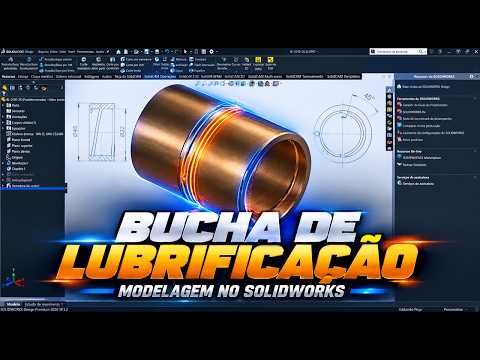
Mastering 3D CAD software is one of the most effective ways to advance your career in mechanical engineering and product design. Among the foundational skills every designer should possess is the ability to create precise, functional mechanical components. In this guide, you will learn how to design a grooved bushing step-by-step using SolidWorks, empowering you to handle practical design challenges with confidence.
Why Master Grooved Bushing Design?
Bushings are indispensable components in mechanical assemblies. They reduce friction, support loads, and guide moving parts. Adding a groove—whether for lubrication, snap rings, or O-ring seals—introduces a vital feature that requires accurate 3D modeling. Learning this technique ensures that your models are not only visually accurate but also fully functional for manufacturing and simulation.
Step-by-Step: Creating a Grooved Bushing
- Create the Base Geometry: Start by sketching the cylindrical body of the bushing. You can draw a simple circle and use the Extruded Boss/Base feature, or sketch a half-profile and use the Revolved Boss/Base feature for greater flexibility.
- Define the Groove Profile: Select a plane that passes through the center of the cylinder (such as the Front or Top plane). Sketch the cross-section profile of the groove where you need it—whether internal or external.
- Apply the Cut Feature: Utilize the Revolved Cut tool in SolidWorks to revolve the groove profile 360 degrees around the central axis of the bushing. If you are creating a spiral or helical oil groove, you can use the Swept Cut tool along a defined helix curve instead.
- Add Details and Finish: Complete your model by adding chamfers or fillets to the edges to remove sharp corners, ensuring realistic manufacturing readiness.
Elevate Your Design Skills
Transforming your engineering career begins with mastering essential tools and expanding your practical CAD knowledge. By building a strong foundation in SolidWorks, you position yourself as a detail-oriented professional ready to tackle complex industrial projects. Start modeling today and take your engineering capabilities to the next level!


