
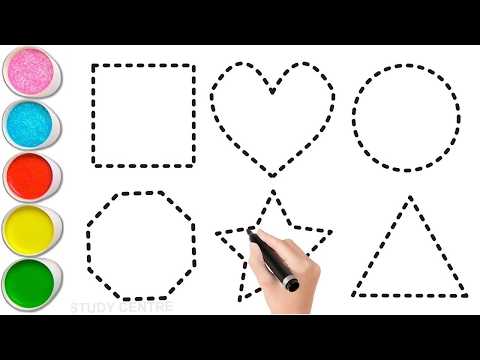
Learning doesn't have to be a chore, especially when it comes to the building blocks of geometry. For young learners, understanding shapes is a foundational skill that bridges the gap between art and mathematics. Introducing children to the world of 2D drawing is an essential first step in helping them recognize the patterns and structures that make up the physical world around them. From the wheels on a car to the windows on a house, shapes are everywhere!
The Power of Tracing Dotted Lines
One of the most effective ways to teach preschoolers how to form shapes is through dotted line tracing. This technique allows children to practice their fine motor skills while gaining confidence in their ability to guide a pen or crayon. Whether it’s the sharp corners of a square or the smooth, continuous curve of a circle, following a guided path helps reinforce muscle memory. As they trace along the lines, they aren't just making marks; they are mastering the fundamentals of 2D drawing and preparing their hands for the more complex task of writing letters and numbers.
Bringing Shapes to Life with Color
Once the outlines are complete, the real creative fun begins! Coloring is more than just an artistic outlet; it helps kids identify and distinguish between different shapes through visual reinforcement. By encouraging children to color within the lines of their newly drawn shapes, parents and teachers help them focus on boundaries and spatial awareness. This interactive approach ensures that "learning time" feels like "playtime," making the educational experience much more engaging and memorable for a child.
Interactive Learning Through Rhymes
Integrating rhymes and songs into the drawing process can significantly boost information retention. When children recite a catchy rhyme about a triangle while they draw its three sides, they are engaging multiple senses at once. This multi-sensory approach—combining visual art, tactile tracing, and auditory cues—ensures that the concept of 2D shapes sticks. By turning a lesson into a song, you remove the pressure of "studying" and replace it with a rhythmic, joyful experience.
Conclusion
Starting a child’s educational journey with fun, hands-on activities is the best way to foster a lifelong love of learning. By combining tracing, coloring, and music, you turn a simple geometry lesson into an exciting adventure. Grab some bright crayons and a few practice sheets today, and watch your little one thrive as they explore the wonderful world of 2D drawing and shapes!


